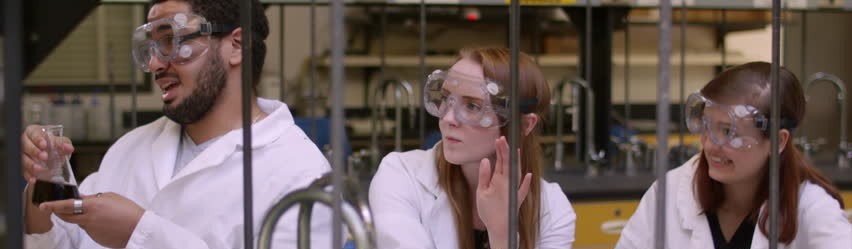
In the words of Aristotle ….. “In all things of nature there is something of the marvelous”.
The science department aims to deliver an experiential approach to learning empowering students to apply scientific knowledge in inquiry-based laboratory investigations. As such, students develop skill in advanced problem solving and learn to apply critical thinking skills in case studies and other activities. There is an urgent need for scientific collaboration which is echoed in the work of scientists involved in global warming, environmental sustainability and conservation. We stress the importance of the scientific method in an attempt to promote freedom of thought while at the same time teaching student collaboration as they acquire new knowledge and learn to access information digitally using advanced communication technologies.
DEPARTMENT MEMBERS
|
Ms. Daley Mr. Heaps Ms. MacNeil
|
Ms. McCrudden Mr. Michaelides Ms. Pauze |
Ms. Ramsewak Mr. C. Smith G. Smith Mr. VanDam (Department Head) |
SCIENCE COURSES
GRADE 9SNC1WI – Science De-Streamed SNC1LB – Fast Forward Science |
GRADE 10SNC2DI – Science De-Streamed SNC2DW – IB Science SNC2LB – Fast Forward Science |
GRADE 11SBI3UW – IB HL Biology 1 SBI3UI – University Biology SBI3CI – College Biology SCH3UW – IB SL Chemistry 1 SCH3UI – University Chemistry SPH3UI – University Physics |
GRADE 12SBI4UW – IB HL Biology 2 SBI4UI – University Biology SCH4UW – IB SL Chemistry 2 SCH4UI – University Chemistry SCH4CI – College Chemistry SPH4UI – University Physics SNC4MW – IB HL Biology 3 SPH4CE – College Physics (E-Learning) |
COURSE DESCRIPTIONS
GRADE 9 COURSES
SNC1WI – This course enables students to develop their understanding of concepts related to biology, chemistry, physics, and earth and space science, and to relate science to technology, society , and the environment. Throughout the course, students will develop and refine their STEM skills as they use scientific research, scientific experimentation, and engineering design processes to investigate concepts and apply their knowledge in situations that are relevant to their lives and communities.
SNC1LB – Fast Forward Program – A modified course that enables students to gain a background in science in our everyday lives, chemistry, electricity, and body systems through labs, assignments, classroom discussions, and hands-on activities.
GRADE 10 COURSES
SNC2DI – Cells and systems in animals and plants, chemical reactions, including acid-base chemistry, climate change, and geometric optics are the topics developed in this course, through labs, assignments, and classroom discussions. Throughout the course, students will continue to develop and refine their STEM skills from SNC 1WI and develop transferable skills as they become scientifically literate global citizens.
SNC1P OR SNC1W
SNC2DW – This course is intended for students who are destined for the I.B. programme. SNC2DW allows students to further develop laboratory investigative skills, and study chemical processes, geometric optics, cellular organization and climate change. This course is only for students who have been accepted into the I.S.P. program at GPSS.
SNC1W
SNC2LB – Fast Forward Program – A modified course that enables students to gain a background in ecology, chemical reactions, electricity, and science in the media through labs, assignments, classroom discussions, and hands-on activities.
SNC1L OR SNC1P OR SNC1W
GRADE 11 COURSES
SBI3UW – This course is the first of three biology courses leading to the Higher Level (HL) Biology component of the I.B. Diploma. Candidates will complete the Group Four Project in the first of the three semesters. Course concepts include statistical analysis, ecology, plant biology, cell biology, biodiversity, genetics and evolution.
SNC2DW
SBI3UI – Biodiversity, evolution, genetic processes, the structure and function of animals, and the anatomy, growth and function of plants are topics examined in this course with a focus on theoretical concepts and skills related to scientific investigation.
SNC2D
SBI3CI – Cellular biology, microbiology, genetics, the anatomy of mammals, and the structure of plants and their role in the environment are topics developed in this course, with an emphasis on practical applications and on skills related to scientific investigation.
SNC2D OR SNC2P
SCH3UW – This course is the first of two chemistry courses leading to the Standard Level (SL) Chemistry component of the I.B. Diploma. SCH 3UW investigates statistical analysis, atomic theory, chemical bonding, solution and gas chemistry, stoichiometric analysis, acids and bases, energy changes and reaction rates.
SNC2DW
SCH3UI – Chemical changes, atomic theory and the periodic table, chemical equations and reactions, the mole and solutions, atmospheric chemistry and the behaviour of gasses, are topics examined through labs, assignments and class discussions with an emphasis on the impact of chemistry on society and the environment.
SNC2D
SPH3UI – Kinematics, forces, energy transformations, the properties of vibrations and waves, sound, electricity and magnetism are topics developed in this course, through labs, assignments and class discussions with consideration of the impact of technological applications of physics on society and the environment.
SNC2D
GRADE 12 COURSES
SBI4UW – This is the second of three biology courses leading to the Higher Level (HL) Biology component of the I.B. Diploma. Candidates will complete the Internal Assessment as a major component of this course. Topics of study include statistical analysis, molecular biology and metabolism, nucleic acids and advanced molecular genetics.
SBI3UW
SBI4UI – Biochemistry, metabolic processes, molecular genetics, homeostasis, and population dynamics are topics examined in this course through labs, assignments, case studies and class discussions. Acquiring detailed knowledge for application and critical thinking and refining skills related to scientific investigation will be emphasized.
SBI3U
SCH4UW – This is the second of two chemistry courses leading to the Standard Level (SL) Chemistry I.B. Diploma. The Group Four Project will be undertaken as an extension with SBI3UW. The Internal Assessment is a major component of this course. Topics of study include organic chemistry, equilibrium, electrochemistry, biochemistry and analytical chemistry.
SCH4UI – Organic chemistry, atomic and molecular structures, energy changes and rates of reaction, chemical systems in equilibrium, and electrochemistry are studied in this course, through labs, class discussions, and assignments with an emphasis on the importance of chemistry in daily life and its impact on the environment.
SCH3U
SCH4CI – Organic chemistry, atomic and molecular structures, energy changes and rates of reaction, chemical systems in equilibrium, and electrochemistry are studied in this course, through labs, class discussions, and assignments with an emphasis on the importance of chemistry in daily life and its impact on the environment.
SNC2D OR SNC2P
SPH4UI – Energy transformations, 2-dimensional motion and the forces affecting that motion, electrical, gravitational, and magnetic fields, electromagnetic radiation and the nature of light, quantum mechanics, and special relativity are topics developed in this course, through labs, assignments and class discussions. Consideration of the impact of technological applications of physics on society and the environment will be addressed.
SPH3U
SNC4MW – This is the third of three biology courses leading to the Higher Level (HL) Biology component of the I.B. Diploma. Course concepts studied include animal physiology, human physiology, homeostasis, neurobiology and behavior.
SBI4UW
SPH4CE – E Learning – This course develops students’ understanding of the basic concepts of physics. Students will explore these concepts with respect to motion; mechanical, electrical, electromagnetic, energy transformation, hydraulic, and pneumatic systems; and the operation of commonly used tools and machines. They will develop their scientific investigation skills as they test laws of physics and solve both assigned problems and those emerging from their investigations. Students will also consider the impact of technological applications of physics on society and the environment.
This is an asynchronous E-learning course.
SNC2D OR SNC2P